Home / ESD Products
Energy Saving Devices · EEXI · CIIWe are a pre-swirl duct and PBCF manufacturer based in Qingdao, delivering CFD-verified, class-approved ESD retrofits that cut fuel consumption by 3–8% — installed at any Chinese shipyard or port, with docking or afloat.
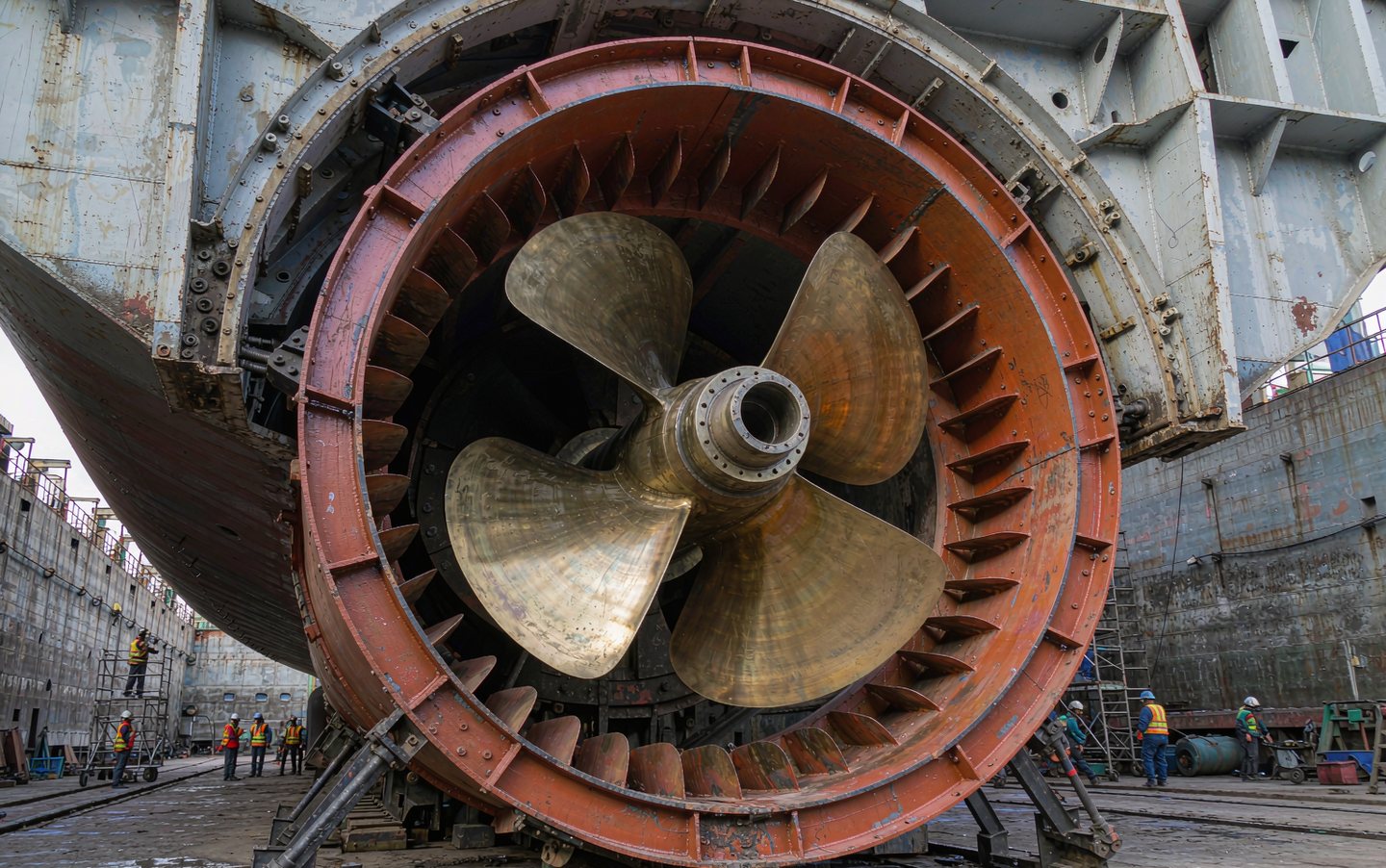
An Energy Saving Device (ESD) is a hydrodynamic appendage fitted to a ship's propulsion system to recover energy that would otherwise be wasted. As the propeller rotates, it induces swirl in the wake and leaves a hub vortex behind it — both represent lost energy. ESDs recover that loss in two ways:
For owners, this is the lowest-risk path to IMO compliance: an ESD retrofit reduces attained EEXI, improves the annual CII rating, and pays back through fuel savings — typically within 12–36 months on a suitable hull.
A wake-equalizing duct mounted ahead of the propeller that pre-rotates the inflow and accelerates it into the blade disc — recovering rotational energy losses. Typically 2–5% fuel saving on full-form vessels (bulk carriers, tankers). Each duct is designed for the specific hull wake using viscous CFD and approved by class.
Fins fitted on the propeller boss cap that eliminate the hub vortex, reducing energy loss and propeller cavitation. Typically 2–4% fuel saving, quick to retrofit — bolted onto the existing boss cap with no welding, installable underwater or during docking in a few hours.
Pre-swirl duct + PBCF combinations deliver up to 3–8% total fuel saving. We run the CFD analysis to confirm the two devices work with — not against — each other on your hull, and supply a single performance guarantee package for class submission.
Hull-form and propeller specific design, CFD verification, class-approved fabrication in our Qingdao workshops, and installation at every major Chinese shipyard — during docking or afloat. We handle drawings, class approval, fabrication, transport and installation as one package.
Send us the vessel particulars, propeller drawing and wake field data. Our CFD team models your hull's actual wake and quantifies the achievable saving before you commit.
Duct geometry and fin pitch are optimized in viscous CFD, then submitted to your classification society (CCS, DNV, LR, ABS, BV...) for approval as part of the EEXI documentation.
Class-approved fabrication in certified workshops — steel ducts with full weld inspection, bronze PBCF castings with CNC-machined fin roots and bolts.
Our installation teams mobilize to your docking window — or fit PBCF afloat by diver. Post-installation report and performance verification included.
Send us your vessel particulars and propeller data — we will come back with a CFD-based saving estimate and quotation, free of charge.
ops@ship-teck.com
Mobile / WhatsApp
+86-18953252826
Head Office
Qingdao, Shandong, China
An ESD is a hydrodynamic appendage fitted to the propulsion system — such as a pre-swirl duct ahead of the propeller or PBCF fins on the propeller boss — that recovers rotational and hub-vortex energy losses, cutting fuel consumption by typically 3–8%.
A wake-equalizing pre-swirl duct typically delivers 2–5% fuel saving on full-form vessels such as bulk carriers and tankers. Combined with PBCF, total savings of 3–8% are achievable, verified by CFD analysis for each hull.
Yes. PBCF is bolted onto the propeller boss cap and can be installed underwater by divers or during a short afloat stop — no welding required. Most owners choose a scheduled drydocking; installation takes about 5–6 hours with a 4-worker team.
Yes. ESD retrofits reduce the attained EEXI by improving propulsive efficiency, and lower annual fuel consumption, which directly improves the ship's CII rating — a recognized technical measure in IMO compliance strategies.